Second World War
The Glass RoomThe Second World War is the historical catastrophe that makes private refuge precarious and gives the Landauer House a brutal second life. The novel renders the conflict through displaced family life, intercepted correspondence, the invasion of the Soviet Union, Nazi occupation, and the rise and failure of the biometric centre: a regime’s attempt to measure racial categories inside a home built around glass and transparency.
War and Exile
For the Landauer family in Switzerland, the war is at once distant news and an immediate condition of exile. Switzerland seems like an island amid a flood of destruction, while wireless reports and newspapers carry the news of marching armies, deaths, refugees, and Paris disappearing under the advance. The image of floodwaters gives political catastrophe a material force: lives and places are swept into its current, even for those temporarily beyond the fighting.
Exile also changes the measure of time. In a lakeside summer, the family’s days pass with the water’s transformations, from morning reflections to metallic blue, evening violet, and night black. This is not the quick time of home but the leaden time of displacement, suspended between paradise and hell. The quiet scene does not remove the war; it shows how war governs life even where armies are absent, by keeping return and safety uncertain.
Letters under Occupation
Correspondence across the distance between Hana and Liesel carries news, affection, and guarded observations. Letters arrive with official stamps bearing an eagle and a swastika, their flaps sealed with labels announcing that they have been opened. Liesel imagines the censors reading banalities while missing the private code embedded in them: surveillance can expose intimate lives without understanding what it sees.
Hana’s coded account of the new occupant of the Landauer House makes that gap between seeing and knowing especially pointed. She calls him dumb, then turns the Czech word into a joke about the name Němec, meaning German. The man is a young, good-looking, reserved scientist conducting an anthropological survey in the house. Hana meets him at Café Zeman, where he is sitting in the window seat she associates with the place, and accepts his invitation to see the house and take part in the investigation so that she can report back to Liesel. Her affectionate letter still closes with messages for Viktor and the children, preserving the intimacy that official inspection cannot quite penetrate.
Invasion and Nazi Rule
The war’s scale breaks into the Swiss family scene through a newspaper map of eastern Europe, its black arrows pointing across the page beneath the headline “Invasion.” The name Barbarossa seems to march across the paper like a monster. The moment makes the invasion of the Soviet Union legible not as an abstract campaign but as an approaching force that interrupts ordinary family life: the children are in the water with Katalin, Viktor reads the paper, and the map’s arrows bring distant violence into their temporary refuge.
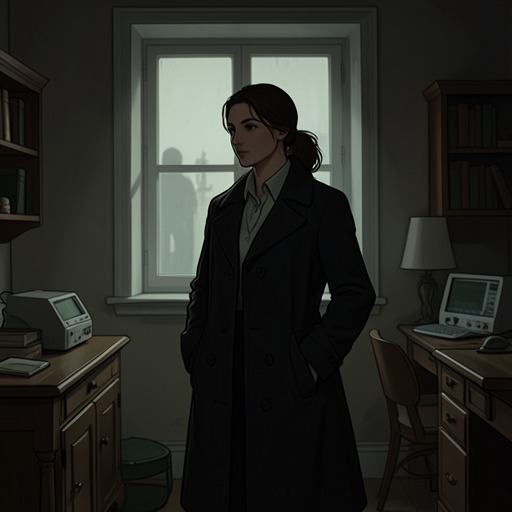
Elsewhere, the novel shows Nazi rule organizing knowledge and power through the biometric centre in the Landauer House. Its staff measure the human body in pursuit of distinctions between Nordic, Slav, and Semitic categories. Stahl watches, enthralled by the systematic measurement of what the regime calls human and subhuman, “Herrenvolk and Untermenschen.” The project translates racial ideology into procedures, instruments, and records, while the former home becomes a place where people are examined according to the state’s classifications.
The centre’s work culminates in the visit of Reinhard Heydrich, the Reichsprotektor. His inspection is preceded by confused rumours and hurried preparations, until an official itinerary fixes the visit for eleven in the morning with the staff on parade. His convoy arrives on time: motorcycles, an officials’ car, and a dark green Mercedes convertible marked SS–3. The ordered spectacle places the biometric project within the hierarchy of Nazi power; the house’s scientific routines are not separate from political authority but subject to its inspection.
Closure and Historical Afterlife
The centre is eventually ordered closed. The Reichsprotektor’s office declares its research unjustified because it has failed to find scientific means of distinguishing Nordic, Slav, and Semitic people. The regime does not respond by questioning whether its racial categories are false; instead, it treats the failure to quantify an assumed difference as proof that the research is defective. Its appeal to what any person of common sense can supposedly detect exposes the political premise beneath the demand for measurement.
The closure disperses the centre’s people and equipment. Personnel pack their cases, receive rail passes for Berlin, Jena, and Leipzig, and leave for the station. Instruments and furniture are packed away, and files are boxed for transfer to Berlin; furnishings go to offices in Město, Prague, and Warsaw. Technicians unscrew the Hollerith machines from the garage floor and load them onto trucks for an undertaking expected to make more fruitful use of them: the new camp complex near Oświęcim. The centre ends, but its machinery does not simply vanish. The transfer gives the episode its grim historical consequence, linking the house’s bureaucratic apparatus to the expanding camp system.
Narrative Significance
The war is presented through shifts of scale and form: a lake’s changing surface, a censored letter, arrows on a newspaper map, a formal inspection, and machines loaded onto trucks. These scenes keep the historical violence connected to objects and routines rather than isolating it as distant background. The movement from a home associated with modern openness to a site of racial measurement, and then to the dispersal of its equipment, makes the Landauer House a concentrated image of how war appropriates private spaces and converts ideology into administrative practice.